
The cost of waiting
Inheriting an Individual Retirement Account (IRA) can be a significant financial windfall, but it comes with strict IRS rules and tight timelines. Following major changes under the SECURE Act and subsequent IRS guidance, calculating and taking your annual withdrawals—known as Required Minimum Distributions (RMDs)—has become a complex tax responsibility.
Many beneficiaries assume they can delay taking money out until the end of a multi-year period. However, missing your inherited IRA distribution deadline carries heavy financial consequences.
Here is what happens when you miss an inherited IRA RMD, how much it will cost you, and why you can no longer count on grace periods—beginning with a real-life scenario of just how easily these rules can create a financial tangled web.
Josh’s Story: Inheritance rules can catch even experienced investors off guard
Recently, an elderly gentleman came into our office. Josh was sharp, fiercely independent, and had successfully managed his own investments his entire life. He didn’t need us to tell him how to invest.
What he did need was insight on detangling a messy web of inherited accounts after his wife passed away.
Not aware of the strict, non-negotiable rules surrounding inherited IRAs, Josh had been trying to do his best on his own. He was withdrawing money from various accounts, but without a clear plan or strategic reason. Sadly, instead of opening the required, dedicated “Inherited IRA” accounts and allocating the assets appropriately, he was simply making sporadic withdrawals directly from his deceased wife’s existing accounts.
Without realizing it, he was walking straight into a minefield of potential IRS penalties, lost tax advantages, and missed Required Minimum Distributions (RMDs).
Fortunately, we were able to step in and put a precise process in motion to clean up the accounts:
- Opened the appropriate Inherited IRA accounts to house the designated funds legally.
- Moved all assets to the correct, newly established accounts to ensure a paper trail.
- Brought in an accountant to coordinate directly with the IRS and verify compliance.
- Reset the cost basis for his wife’s portion of their joint brokerage account (a crucial, highly beneficial tax step that many self-directed individuals completely overlook).
Because of this fast course correction, Capstone helped Josh avoid thousands of dollars in unnecessary fines, penalties, and interest.
But why are the stakes so high? Let’s look at the penalties he almost faced.
What is the Penalty for Missing an Inherited IRA Distribution?
If you fail to take a required minimum distribution from an inherited IRA by the December 31 deadline, the IRS imposes a 25% excise tax penalty on the shortfall.
Example: If your required minimum distribution for the year was $20,000 and you failed to take any of it, your penalty would be $5,000 (25% of $20,000). This penalty is charged in addition to any ordinary income taxes you owe on the distribution.
For the client in our story, simply withdrawing money from the wrong account wouldn’t have satisfied the RMD on the IRA. In the eyes of the IRS, he would have missed his distribution—and could have faced thousands of dollars in penalties on those untouched assets.
The 10% Correction Window
Under SECURE Act 2.0 rules, there is a way to reduce this severe hit. If you catch and fix the error within a specific two-year “correction window,” the penalty drops from 25% to 10%. To qualify for the reduced 10% penalty, you must:
- Withdraw the missed RMD amount as soon as you notice the error.
- File IRS Form 5329 with your federal tax return for the year the distribution was missed.
- Pay the reduced excise tax before the end of the second calendar year following the missed deadline.
While 10% is better than 25%, it remains a costly tax mistake on money meant to build your net worth.
Why the Grace Periods Are Officially Over
To understand why so many beneficiaries are being caught off guard, you have to look back at the SECURE Act of 2019.
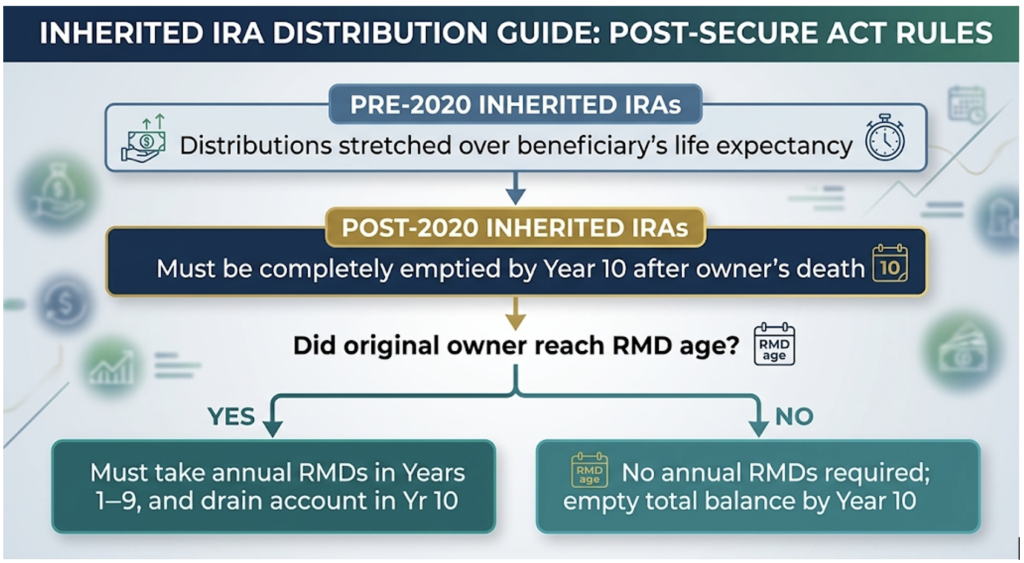
Before 2020, non-spouse beneficiaries could “stretch” inherited IRA distributions over their entire life expectancy. The SECURE Act eliminated the stretch IRA for most non-spouse beneficiaries, replacing it with a 10-Year Rule requiring the account to be fully emptied by the 10th year following the owner’s death.
The IRS created widespread confusion when interpreting this rule. They determined that if the original account holder had already started taking their own RMDs before passing away, the beneficiary must continue taking annual RMDs in years 1 through 9, in addition to draining the full account by year 10. (As our client learned, surviving spouses also face specific rules and elections—such as keeping the account as an inherited IRA or doing a spousal rollover—which dictate how and when distributions must begin).
Because this requirement surprised millions of heirs, the IRS granted temporary transition relief. They waived the excise penalties for missed annual distributions for tax years 2021, 2022, 2023, and 2024. That temporary grace period has officially ended.
The IRS final regulations make it clear: enforcement is active, and penalty waivers are no longer automatic. Beneficiaries subject to annual RMDs must satisfy their distribution requirement by December 31 every year or face the full 25% penalty.
Common Reasons Beneficiaries Miss Their RMDs
Like our self-directed client, it is surprisingly easy to miss an inherited IRA withdrawal. The most common traps include:
- Assuming the 10-Year Rule means waiting until Year 10: If the original owner was already taking RMDs, you cannot simply wait until year 10 to withdraw the whole balance; you must make annual withdrawals.
- Failing to Register Accounts Correctly: Like the gentleman in our story, you cannot simply leave the assets in the deceased’s name and draw from them. The assets must be moved to properly registered “Inherited IRA” (or “Beneficiary IRA”) accounts.
- Assuming Custodians Do It Automatically: Financial institutions manage account assets, but they rarely auto-distribute inherited IRA funds. The responsibility falls entirely on you as the beneficiary.
- Inheriting Multiple Accounts: If you inherit multiple traditional IRAs from different people, you must calculate each RMD separately—and aggregating withdrawals across inherited and personal IRAs follows complex rules.
- Miscalculating Life Expectancy Factors: Inherited IRA RMDs rely on the IRS Single Life Expectancy Table, subtracting one year for each year that passes after the owner’s death. Using the standard Uniform Lifetime Table used for original account holders yields incorrect calculation amounts.
How to Fix a Missed Inherited IRA RMD
If you realize you missed your distribution deadline, take these steps immediately to minimize damages:
- Calculate and Withdraw the Shortfall: Take out the exact dollar amount missed as soon as possible. Keep this withdrawal distinct from your current year’s RMD.
- File IRS Form 5329: Complete Form 5329 (“Additional Taxes on Qualified Plans…”) for the specific tax year the RMD was missed.
- Request a Waiver (if applicable): If you missed the deadline due to a reasonable cause (e.g., severe illness, death in the family, or incorrect advice from a financial institution), you can submit a written statement of explanation with Form 5329 requesting a full penalty waiver.
In our client’s case, moving quickly to open the correct Inherited IRA accounts and coordinating with his accountant allowed us to satisfy the requirements, prove good faith, reset the cost basis on other joint assets, and keep his hard-earned money out of the hands of the IRS.
Protect Your Inheritance with Proactive Planning
A missed RMD penalty strips away up to a quarter of your inherited wealth before taking regular income taxes into account. You may have the experience and confidence to manage your own investments, but navigating the administrative, legal, and tax requirements of an inherited estate is an entirely different challenge.
With the IRS actively enforcing post-SECURE Act distribution rules, navigating these deadlines requires precision.